
The Birth of DevOps
An Overnight Tech Trend That Took A Decade

DevOps has seemingly emerged overnight but this tech trend began a decade ago.
It is a software engineering phrase which is based on a marriage between software development and software operations. It’s a hybrid of two kinds of software work.
DevOps = Dev (from software development) + Ops (from software operations)
DevOps Teams are made of what used to be separate and independently working two silos of tech professionals - developers and operations specialists. Reasons for this include saving time, reducing friction and increasing the speed of fixes and changes.
The first DevOps conference was in Belgium in 2009 and this philosophy picked up momentum about 5 years later in 2014. A chart showing the rate of DevOps adoption visualizes double digit growth -- driven by the growth of infrastructure and drop in costs.
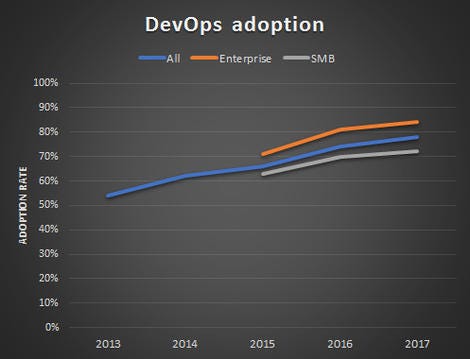
The catalyst for the growth of DevOps philosophy was the rise of Cloud infrastructure.
Tech Infrastructure has moved on from customer owned servers hosted in data-centers to the Cloud’s massive server farms of virtual machines and beyond. Over the past couple of decades Tech platforms, including Amazon, Apple, Facebook, and Google, in their constant growth race had forced a change in “Software Development Lifecycle” (“SDLC”) practices and techniques. To maintain growth and competition, changes had to be implemented faster at the same time stability and security had to be maintained.
DevOps has grown quickly to take a dominant share of IT work practices but it’s still early days -- and “academics and practitioners have not developed a unique definition for the term "DevOps””.
One definition for the DevOps comes from Wikipedia:
DevOps is a set of software development practices that combine software development (Dev) and information-technology operations (Ops) to shorten the systems-development life cycle while delivering features, fixes, and updates frequently in close alignment with business objectives
This is a philosophy which encourages the “[transformation of] the way operations, developers, and testers collaborate during the development and delivery processes”.
When business customers meet and work with DevOps consultants today, it is likely it is not through a collection of separate teams but with merged teams working continuously.